The Matrix Sikar RMO 2026 selections stand at 19 students. These students cleared IOQM 2026, the Indian Olympiad Qualifier in Mathematics, and have qualified for the Regional Mathematical Olympiad (RMO), which will be held on Sunday, 15 November 2026.
Matrix Sikar says this is the highest number of RMO selections in Sikar this year, and that 72 of its students have qualified for RMO over the past four years. If you are in Class 8 to 12, you may be asking, “Sir, how does a student reach RMO, and what comes after it?” This blog gives the list of the 19 students, the RMO 2026 details from the official sources and a simple preparation plan.
Which Students from Matrix Sikar Qualified for RMO 2026?
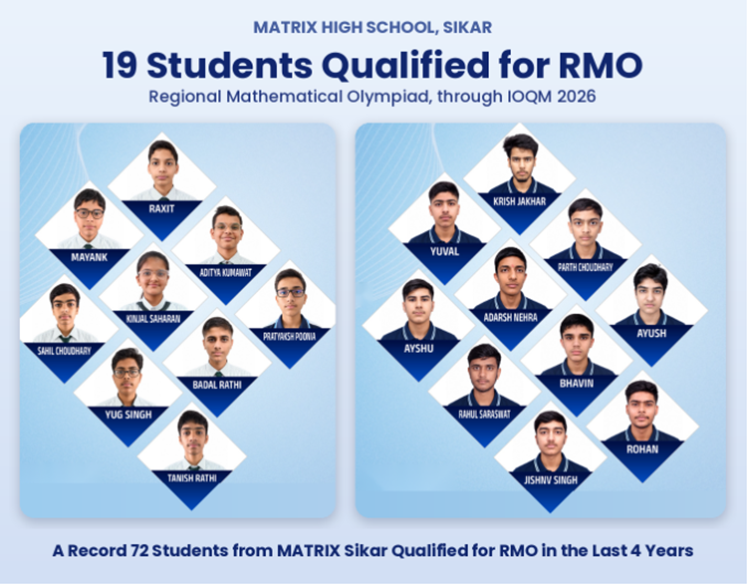
The names below are given as they appear on the result poster shared by Matrix Sikar and Matrix High School.
| S.No | Student Name |
|---|---|
| 1 | Raxit |
| 2 | Mayank |
| 3 | Aditya Kumawat |
| 4 | Kinjal Saharan |
| 5 | Sahil Choudhary |
| 6 | Pratyaksh Poonia |
| 7 | Yug Singh |
| 8 | Badal Rathi |
| 9 | Tanish Rathi |
| 10 | Krish Jakhar |
| 11 | Yuval |
| 12 | Parth Choudhary |
| 13 | Adarsh Nehra |
| 14 | Ayush |
| 15 | Ayshu |
| 16 | Bhavin |
| 17 | Rahul Saraswat |
| 18 | Rohan |
| 19 | Jishnv Singh |
What Is the RMO 2026?
| Detail | RMO 2026 |
|---|---|
| Exam | Regional Mathematical Olympiad (RMO) 2026 |
| Date | Sunday, 15 November 2026 |
| Time | 1:00 pm to 4:00 pm |
| Duration | 3 hours |
| Paper | 6 problems of 17 marks each, maximum 102 marks |
| Type | Written, pen and paper; each problem needs a detailed proof |
| Registration | Starts on Monday, 2 November 2026, as per the IOQM portal |
| Organisers | HBCSE (TIFR) for NBHM, Department of Atomic Energy |
| Next stage | INMO 2027 on Sunday, 17 January 2027, 12:00 noon to 4:30 pm |
Note: If RMO cannot be held in a region because of unavoidable circumstances, the brochure says an alternative date may be announced for that region.
How Does a Student Reach RMO?
The first stage is IOQM, which was held on Sunday, 6 September 2026, from 10:00 am to 1:00 pm and conducted by the Mathematics Teachers’ Association (India). It is a three-hour paper with 30 questions, and every answer is an integer from 00 to 99 marked on an OMR sheet. Ten questions carry 2 marks, ten carry 3 marks, and ten carry 5 marks, so the paper is out of 100, and there is no negative marking. Students born between 1 August 2007 and 31 July 2014 and studying in Classes 8 to 12 were eligible to write it.
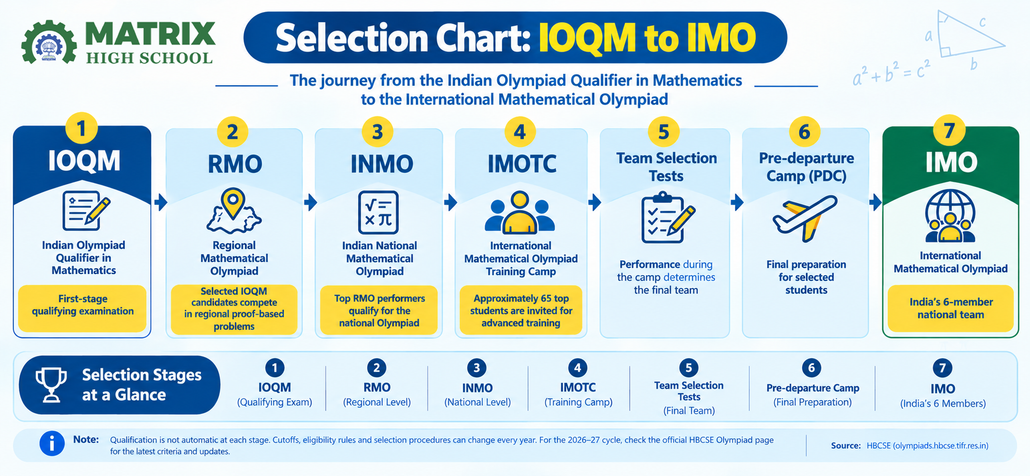
To qualify for RMO, a student needs at least 10% of the total marks, which is the minimum. After that, students are ranked within their region. Students of Classes 8 to 11 form Category A, and students of Class 12 form Category B. From each region, the top 200 students of Category A and the top 40 students of Category B qualify, along with students tied at the last position. Five additional girl students from Category A also qualify from each region. The region of a student is decided by the postal address of the school.
What Is the RMO 2026 Cutoff for Rajasthan?
The MTA(I) portal has published the IOQM to RMO 2026 cutoffs for every region. The cutoff scores for Rajasthan, which is Region 10, are below. Schools in Sikar come under this region, since the region is decided by the postal address of the school.
| Region | Category A | Category A girls | Category B |
|---|---|---|---|
| Rajasthan | 44 | 42 | 52 |
The portal says students with flags were removed before the cutoffs were calculated. It lists one cutoff for the whole region and no separate cutoff for Sikar.
What Happens after RMO?
From each region, the top 30 students in Category A, the top 6 students in Category B, and 5 additional girl students in Category A qualify for INMO 2027. INMO is a four-and-a-half-hour paper with 6 problems, each of 17 marks. Based on INMO, the top 48 students from Classes 8 to 11 and the top 12 students from Class 12 across the country become INMO awardees. The brochure states that the results will be declared in the last week of February or the first week of March 2027.
INMO awardees are invited to IMOTC 2027, a month-long training camp in April and May. The team of the best six students is selected from the selection tests held in the camp, and that team goes to the 68th International Mathematical Olympiad in Budapest, Hungary, in July 2027.
Why Does Reaching RMO Matter for a Student?
First, Olympiad maths builds the habit of thinking. You meet problems you have never seen, so you try an idea, test it, drop it and try another. This habit helps in later exams, and in college maths and engineering too.
Second, qualifying gives confidence in the next exam. Third, Olympiad practice covers topics that also appear in JEE in more detail, so JEE maths can feel more familiar afterwards. Fourth, a student who becomes an INMO awardee can write INMO the next year directly, without writing IOQM and RMO again, if the other eligibility conditions are met.
How Do Students Prepare for IOQM and RMO?
Preparation starts with the basics. Revise Class 9 and 10 algebra and geometry until every theorem feels easy. Then move to divisibility, congruences, inequalities, triangle properties and counting methods. Without these basics, the hard problems are difficult to even start. The official syllabus is on the HBCSE website, and it excludes Calculus and Statistics.
Next, practise problems where no formula fits directly. Start with one problem a day and give it one full hour before you look at a hint. If you still cannot solve it, read the hint, close the book and finish the solution yourself. Trying the problem first makes the hint easier to understand.
After solving, write the full solution as if a teacher is checking it. RMO problems carry 17 marks each and need detailed proofs, so ask a teacher or a senior to read your solution and point out the gaps. Keep a small notebook for mistakes, and write the idea you missed next to each one. Before the exam, solve previous year papers in the same time you get in the exam hall.
Does Olympiad Preparation Help in JEE?
It helps in some parts. Algebra, coordinate geometry, permutations and combinations, and number-related questions also appear in JEE, and a student who has worked on Olympiad problems finds them more direct. Even then, qualifying for RMO does not guarantee a good JEE rank. JEE Main needs speed and accuracy over a wide syllabus, and Olympiad practice takes time that you must plan carefully.
A simple plan is to set aside two or three fixed days each week for Olympiad problems and use the other days for JEE practice and chapter tests. If your school marks or JEE test scores start falling, reduce the Olympiad hours and return to your earlier plan.
What Should the 19 Students Do Next?
RMO is on Sunday, 15 November 2026, so there is little time left to prepare. Registration opens on Monday, 2 November 2026, so check the IOQM portal for the steps and complete them as soon as they open. Solve previous year RMO papers slowly, one problem at a time, and write every proof in full. Ask a teacher to read your proofs, and try the problems you could not finish again after two or three days. Keep up your school studies and sleep.
What Can Other Sikar Students Learn from This Result?
If you are in Classes 8 to 10, you have time. Begin with one hard problem a week and slowly increase it. For reference, the IOQM 2026 fee was 300 rupees for most students and 180 rupees for Kendriya Vidyalaya and Jawahar Navodaya Vidyalaya students, and each student could register only once. If you are in Class 11 or 12, give Olympiad topics a fixed slot next to your JEE maths. Parents can help by asking the child to explain a solution aloud.
Frequently Asked Questions
Nineteen, according to the Matrix Sikar announcement.
Sunday, 15 November 2026, from 1:00 pm to 4:00 pm.
Monday, 2 November 2026, according to the IOQM portal.
The portal lists 44 for Category A, 42 for Category A girls and 52 for Category B.
INMO on Sunday, 17 January 2027, then the IMOTC training camp for INMO awardees.
Yes, because many JEE maths topics get a fuller treatment in Olympiad problems. Plan your time so that JEE practice and school marks stay at their usual level.
Pick one non-routine problem, give it one full hour and write the solution neatly. All the best.